[Facebook]: Will 2015 Be the Year of Worrying About Employee Burnout?

Tags

,

Here’s a good article on employee burnout and work overload. But, it is quite interesting that after all the statements about overload, the section “What managers need to do” says nothing at all about reducing the overload and pushing back, just ways to react to it. It is almost suggest that this is sacrosanct, and we all have no ability to do anything about it.

http://www.tlnt.com/2014/12/23/will-2015-be-the-year-of-worrying-about-employee-burnout/

Cross-posted from Facebook via IFTTT

A celebration of my readers

You may already know I write a blog on Forbes.com and have done so on and off since 2010. I just recently passed a milestone in readership, sometime on Dec 9th:

Reached 100,000 readers in one year of my Forbes.com blog

It’s a nice round number and I’d like to take the opportunity to thank all my regular and occasional readers. I don’t put as much on this personal blog certainly, but then I have a number of places to share all at the same time. The various other locations (LinkedIn articles, slideshare, and various social content places) add up tens of thousands more, but it takes work and time to focus energies into one place.

Thank you everyone!

2015 is going to be an interesting year as well, I promise.

Stocks and Flows of Knowledge just turned 25!

Tags

,

The idea of Knowledge Stocks and Flows just turned 25 years old this month! Considering how much this is highlighted in social business, collaboration, the collaborative economy, self-management and other topics today, we should celebrate.

I think the first paper that I can find that suggests this idea was Dierickx & Cool (INSEAD) in December 1989, as “Asset Stock Accumulation and Sustainability of Competitive Advantage“, in Management Science, Vol. 35, No. 12

This later is reprised in David Deeds & Donna DeCarolis (1999) paper “The Impact of Stocks and Flows of Organizational Knowledge on Firm Performance: An Empirical Investigation of the Biotechnology Industry“, in Entrepreneurship Faculty Publications. Paper 4, of the Univ. of St Thomas, Minnesota

Then again by Morris, Snell and Depak of Cornell (2005), “An Architectural Approach to Managing Knowledge Stocks and Flows: Implications for Reinventing the HR Function

And more recently raised by John Hagel, John Seely Brown, and Lang Davison in their book, The Power of Pull (2012).

To go even further back, one might argue that Friedrich Hayek’s seminal work, The Use of Knowledgepublished in 1945 in the American Economic Review, precedes all these, making knowledge flows about 60 years old!

I’ve bundled links to some of these papers here: https://bitly.com/bundles/rawnshah/l

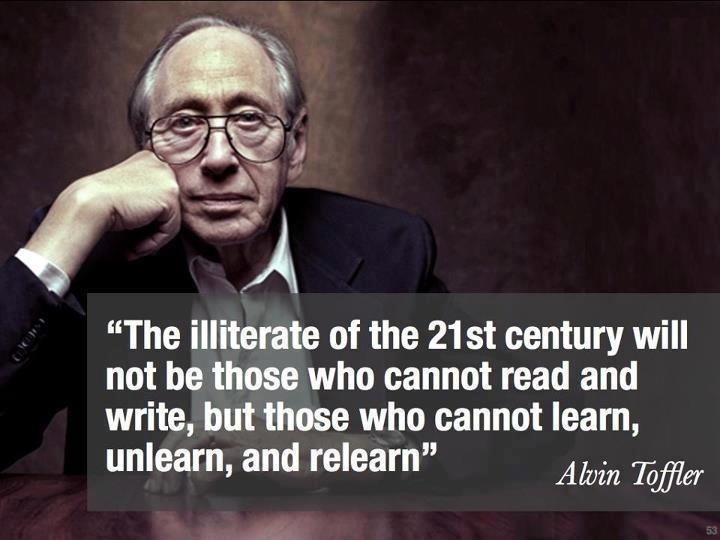
toffler-learn

Work Culture At HR Tech Europe 2014

Tags

, ,

I’m back from Amsterdam and Brussels, after an intense 9 days of speaking at HR Tech Europe 2014, and then meetings with great folks in the area.  I had some nice conversations with Frederic Williquet and Leon Benjamin (Sei Mani), Euan Semple, Dan Pontefract (TELUS), Ea Ryberg Due and Cerys Hearsey (Postshift), Aad Boot (LeadershipWatch), as well as with Ray Wang and Holger Muller (Constellation Research). I’ve met some interesting folks in the HR space as well: David Wilson (elearnity), Mervyn Dinnen, David D’Souza, and Kate Graham.

I also had an enlightening dinner discussion with Frederic Laloux, author of Reinventing Organizations, and the evolution of organizational leadership. Look for a book review on Forbes coming soon.

My talk “Why can’t you understand me? Analyzing Collaboration Culture Clashes” focused on what we think of as work culture and the different influences that really make up our DNA. I then looked at how what we mean in our conversations is fractured or refracted through a prism effect of working digitally.

I’ve also blogged twice on LinkedIn and will post another on Forbes soon:

I think this focus on the changes to how we work together because of digital collaboration will affect what it means to be an effective leader and how we develop talent in organizations, going forward.

-rawn

Communications patterns of different global cultures

Tags

,

Business Insider shared this image from Richard D. Lewis’ book, When Cultures Collide: Leading Across Cultures (Nicholas Brealey Publishing 2006), which I found quite interesting. Richard D. Lewis is the founder of the Berlitz Schools of Languages, and creator of the Lewis Cross-Cultural Communication model that classifies cultural norms.

The author developed a visual metaphor to describe how people negotiate deals through conversations and interaction, shown here across American, Canadian, English, French, Italian, German, Chinese (mainland), Hong Kong, Israeli, Indian, Swiss, Singaporean, Australian, Korean, Indonesian, Hungarian, Finnish, Norwegian, Danish, Norwegian, and more.

These are of course stereotypes and not all are flattering. But that positive or negative view of the interaction pattern also depends on the culture you are from.  What you might consider inefficient in one view, others from that culture may consider yours too unfriendly. What I consider more significant is one’s ability to understand and work with other cultures regardless of the bias and conflict one might have.

Mr Lewis also has another book that bears investigation, When Teams Collide: Managing the International Team Successfully (2012) and is closer to work concerns in which I’m interested, particularly cultural views and being able to lead across cultures.

I think few people have the cultural and work experience to verify these patterns but perhaps we could do it through crowdsourcing. Anyone care to share their view of the pattern per their country’s culture?


Communications Patterns around the World.

 

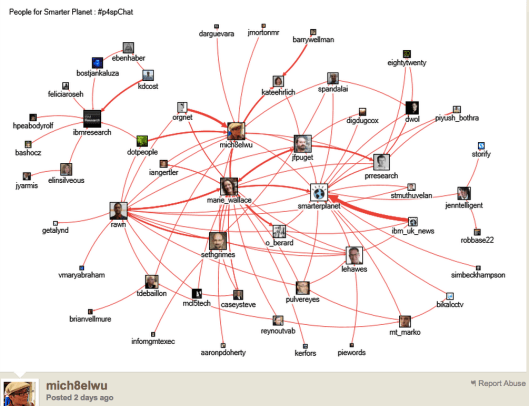
Recap of the #P4SPchat: Turbo-charge your Enterprise with SNA

Tags

, , ,

Thanks to Marie Wallace and the team at IBM, here is a recap of our tweetchat around Social Analytics, held on April 24, 2014. It was a lively discussion with six guests and our host Marie:

  • CEO @Ripple Technologies, David O’Leary (@dwol)
  • Chief Scientist, Lithium Technologies, Michael Wu (@mich8elwu)
  • Head of Analytics @ W2O Group, Seth Duncan (@PRResearch)
  • Distinguished Engineer @ IBM, Jean Francois Puget (@JFPuget)
  • Social Science Researcher @ IBM, Kate Ehrlich (@KateEhrlich)
  • Analytics Strategist @ IBM, Marie Wallace (@marie_wallace)
  • and myself

Other notable participants include @jyarmis, @MarkTamis, @pulvereyes, @lehawes, @alanlepo, @O_Berard, @SethGrimes, @aaronpdoherty, @tdebaillon, @caseysteve, and @BrianVellmure. Thank you all for joining us. 


From Jive – March 2014 Insights from Social Business Thought Leaders

Tags

A nice mention in Jive Software’s slideshare:

“More and more people are working when, where, and with whom they need, organized in patterns they discover as the real way they can operate in the organization that gives them meaning and builds engagement. This creates the multiple dimensions of agility at work that we need…” Rawn Shah Chief Strategy Officer, Alynd @rawn