
• Home
  • About
    • Rawn Shah
    • Photos
    • Video & Audio
    • Cooking
  • Current Interests
    • Work Ethos
    • Collective Collaboration
    • Leadership Values
    • Enterprise Adoption
    • Process Transformation
    • Social Analytics
  • Speaking & Appearances
    • In the News
  • My Books
    • Social Networking for Business (2010)
    • Service Oriented Architecture (SOA) Compass (2006)
  • Book Reviews
  • Contact

The Reconnected Organization

The Reconnected Organization

Tag Archives: employment relationship

What jobs are left for Humans?

02 Tuesday Jul 2024

Posted by rawnshah in Thoughts

≈ Leave a comment

Tags

AI, artificial-intelligence, asynco, automation, distributed work, e20, economics, economy, employment relationship, Enterprise 2.0, future of work, Humans+AI, slideshare

Humans, AI and Future of Work beyond Services-based Economies

About 11 years ago, I shared a prediction that has since become very relevant with the rise of AI. My presentation at Enterprise 2.0 Paris 2013 looked at the future of job roles and job tasks given the evolution of technologies to support collaborative work. Now let’s take a look at the years ahead at what might happen as Humans and AI go to work in the same world. Will AI simply take over our jobs? Will jobs for people transform? Will we all need AI skills? What remains for humans to do?
TLDR: National economies tend to follow an evolutionary pattern for industries: Agriculture first, then Goods Production, and then Services. Each of these eventually lead to innovative automations that requires less human effort to execute, while contributing to the economic development of the nation. We then look to the next industry as the future of work. With many countries having reached the services industry, is here anything beyond ? We seem to be on the path where Automation and AI can tackle or accelerate many production or service tasks to support humans, but what types of work specifically are left for people?

A not-so-secret long-term trend is for national economies to go through evolutionary stages of economic development starting with agriculture, then manufacturing, and finally to services. Slide 13 from my presentation shows data from the International Labor Organisation, the ILO. As nations evolve economically, pre-existing industries (e.g. agriculture) continues to persist though on a lesser significance relative to the national GDP, while the economy focuses on the next industries. This happens on the multi-generational scale (more than a century).
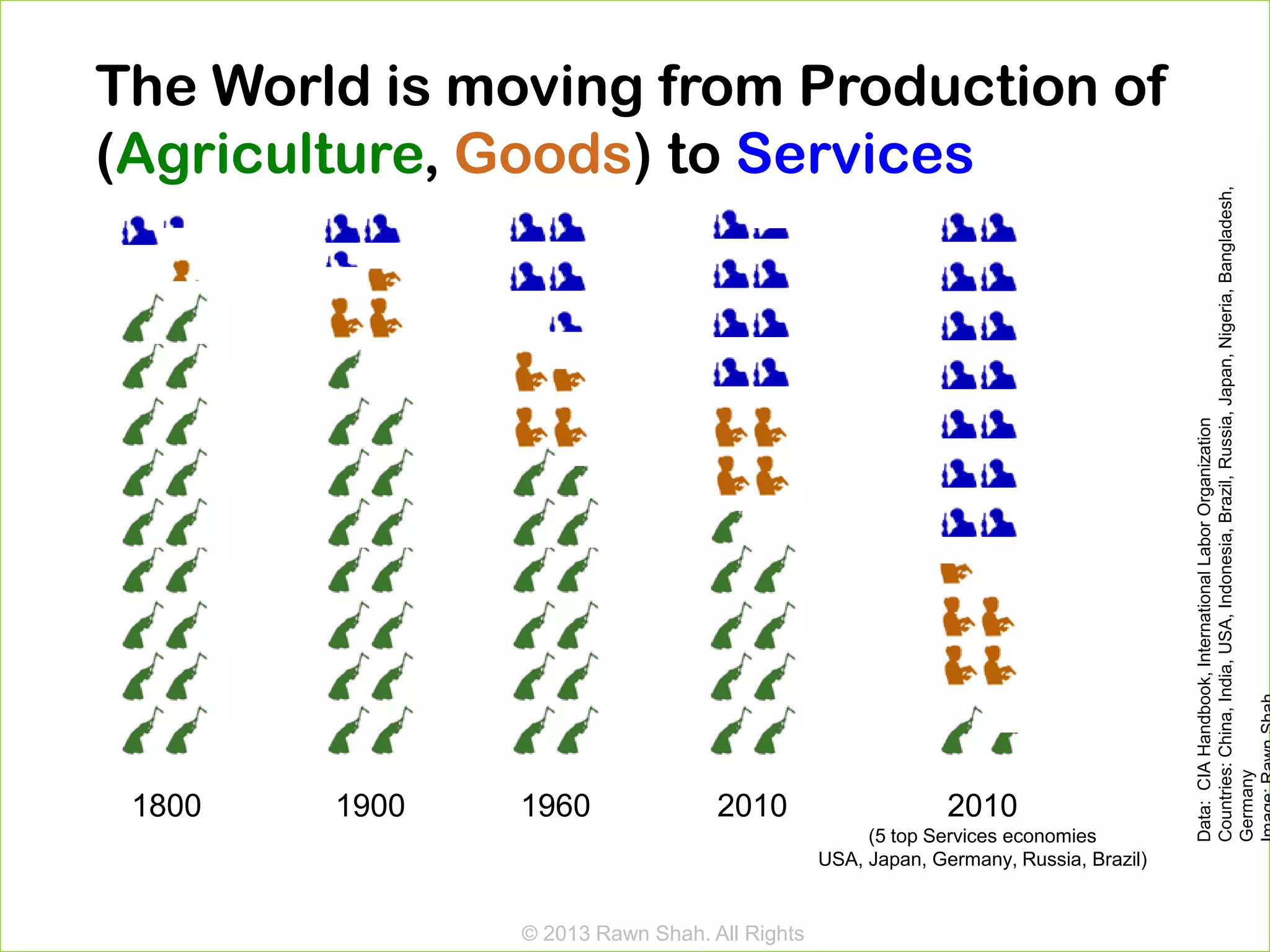
Fig 1. Evolution from Agriculture- to Service-based economies (source: Rawn Shah)

Think of it, the UK (and the British Empire before it), India, and the US have all gone through or are still in progress in these economic evolutions. In each case, we still have agriculture and goods manufacturing, but the next great opportunity seems to lies elsewhere. Today, the great opportunity seems to be in the Services-based industry that can employ a lot of thinking and working minds, while manufacturing is the midst of shifting to more affordable locations.

Each industry tends to gain enough automation and wealth for the citizens get into the next industry, with the view to a more prosperous future. Given that earlier generations of automation accelerated the productivity and output of Agriculture and Manufacturing, it shouldn’t be surprising for this same evolution to come to the Services industry next. 

Economic Person1 seems to be constantly in search of finding better ways to do less work.

What does the services-based economy really get us?

In short, business agility. Nearly two decades ago, when I was focused on an emerging software technology concept called Services-Oriented Architecture (SOA), the premise was that business and technical service tasks could be defined in a digital form that can then be combined as components like Legos to build new services, enabled by ubiquitous fast network access.

Flash forward today, Web services and SOA are the hidden force behind the enormous success of the cloud industry and software APIs. Many radical businesses have emerged quickly in the digital economy because such software-defined services have been easy to rent and assemble as new market offerings. We now commonly speak of a growing speed or pace of business.

With enough ingenuity, Economic Person can invent new businesses faster than ever before without having to build them up from raw stock materials, or seen another way, our new raw stock materials are significantly more complex and useful with results far easier to build and deliver to market.  That acceleration to society’s productive capacity pinned on several key ideas: service-based design and APIs, easy composability, networks, and cloud capacity rental.

This is of course a techno-centric view, but a similar model exists outside software service businesses in exchange markets selling almost any component you can think of on the likes of Alibaba (more B2B) and Amazon (more B2C).  Another area is in the volume of business partnerships and cross-dependencies of supply chains. Proof enough was just how much all sorts of businesses came to pause when they lacked inventory as global supply chains were disrupted during the pandemic.

All this still requires people though. Economic Person is still quintessentially human.

So, what comes next after the Services-based economy?

The Services-oriented economy has given rise to a new problem of its own: there are simply too many services out there.  In parallel, there is too much information available on the Internet (where it is freely accessible). With the number of business and individuals across the global Net, the quantity of available business services are googleplexious in variety and quantity. Inside organizations, internal systems have mirrored the problem on a smaller scale: too many service endpoints and much data to comprehend easily.

And so, Economic Person went down the Big Data road.

Analytics and machine learning made the trip so much easier to comprehend and process all that information, but we also needed an active intelligent agent to work as a proxy for us. Why drive, when you can be driven?

Economic Person asked for a chauffeur, and IT drove us right down towards machine learning and generative AI.

What is left for us mere humans?

There is a lot of chatter about what kinds of job roles will still exist in the future given all the hype and promise of AI. An example speculation: If an AI can pass a law exam — very much in the service industry – how long before we have automated lawyers?  If we were to co-exist, then how exactly can humans and AI collaborate and provide value?

I’m going to explore this further in the next post, though I’d like to share two recent communities of smart folks engaged in conversations around collaboration of humans and AI.

In our community focused on distributed work culture, Asynco.org, Luis Suarez led a discussion on the impact of GenAI and Knowledge Management focusing on how AI affects people, processes, and technology. This is a great humanistic discussion on the impact on people and the security, veracity, and reliability of knowledge generated through AI.

I also came across a good explanation of this Human & AI collaboration when I saw futurist Ross Dawson’s table on LinkedIn recently, focusing on Levels of AI delegation in Decision-making (see Figure 2). Per Dawson, this is from a little while ago, and I offered to collaborate on it.

To that end, I’ve jumped on board with the Humans+AI community to explore this taxonomy of people collaborating with AI. We are looking to fine tune the categories, and document real examples. Stay tuned for more news on that.

A table showing the Levels of AI delegation in Decision-making (source: Ross Dawson)

Fig 2. Levels of AI delegation in Decision-making (source: Ross Dawson)

Let’s catch up in my next piece with look at the categories and types of tasks for people considering the impact of AI.

  1. I will not refer to this character as ‘Economic Man’. ↩︎

My TED talk – The Future of Finding Work

30 Tuesday Jun 2015

Posted by rawnshah in Speaking

≈ Leave a comment

Tags

collaborative economy, conferences, employment relationship, future of work, multi-work, platforms, TEDx

At TEDxBedminster, May 19th 2015:

[Facebook]: Workers on tap

06 Tuesday Jan 2015

Posted by rawnshah in Uncategorized

≈ Leave a comment

Tags

employment relationship, Facebook

Even The Economist is in on the issues of multiployment:

“The on-demand economy is already provoking political debate…
Society gains because idle resources are put to use.
…
The truth is more nuanced. Consumers are clear winners; so are Western workers who value flexibility over security, such as women who want to combine work with child-rearing. Taxpayers stand to gain if on-demand labour is used to improve efficiency in the provision of public services.
…
This sense of nuance should inform policymaking. Governments that outlaw on-demand firms are simply handicapping the rest of their economies. But that does not mean they should sit on their hands. The ways governments measure employment and wages will have to change. Many European tax systems treat freelances as second-class citizens, while American states have different rules for “contract workers” that could be tidied up.
”

http://ift.tt/1wBntnC

and

http://ift.tt/1wADcTS
Workers on tap
“IN THE early 20th century Henry Ford combined moving assembly lines with mass labour to make building cars much cheaper and quicker—thus turning the automobile…”

Cross-posted from Facebook on January 06, 2015 at 01:08PM

[Facebook]: Platform Cooperativism vs. the Sharing Economy

05 Monday Jan 2015

Posted by rawnshah in Uncategorized

≈ Leave a comment

Tags

employment relationship, Facebook

Trebor Scholz, Associate Professor for Culture & Media at The New School and chair of The Politics of Digital Culture conference series writes

“There isn’t just one, inevitable future of work. Let us apply the power of our technological imagination to practice forms of cooperation and collaboration. Worker–owned cooperatives could design their own apps-based platforms, fostering truly peer-to-peer ways of providing services and things, and speak truth to the new platform capitalists.

I have been part of cooperatives all my life; I lived in communes, I experienced first hand how they can put people at the center of the equation. But you’d be mistaken if you think that I have an idealized view of everything cooperative. To start with, millennials might stress their individual careers over an allegiance to any given co-op, and then the problem of competition with global corporations that are rolling in money is a key challenge. And while Silicon Valley’s turbo capitalists are zipping ahead, social movements as well as regulators can be slow. For hackers, “long tail workers,” and labor activists, now is the time to step up their efforts before the network effect chisels brands like Uber into stone.
”

He talks about Platform Cooperativism, which I would describe as the organization’s viewpoint of how work is being done under their banner. Crowdsourcing models fit under this concept I think. Some of the models of Tapscott’s Multi-Stakeholder Networks (MSNs) also seem to fit here.

I look at it from the opposite end, the individual’s viewpoint, and their ability to do work where they want for different entities or organizations, in a state of multiployment.

Whichever view, he is correct in that there are many pitfalls that favor and heavily the organization over the people who do the work.

http://ift.tt/1wG4Gxx

cc: Jeremiah Owyang, Lance J Richards, Bill Jensen, Don Tapscott
Platform Cooperativism vs. the Sharing Economy
“The backlash against unethical labor practices in the “collaborative sharing economy” has been overplayed. Recently, The…“

Cross-posted from Facebook on January 05, 2015 at 01:10PM via IFTTT

[Facebook]: Global Workforce Crisis — by BCG (Pinterest – Work Ethos)

05 Monday Jan 2015

Posted by rawnshah in Uncategorized

≈ Leave a comment

Tags

employment relationship, Facebook, future of work

To add to Rainer Strack’s TED presentation that I shared on Friday, here is more info on the coming $10Trillion global talent shortage crisis.

Here is the chart of projections of labor shortages in 2030 in 25 advanced economies, with two models of projections based on 10 year and 20 year trends.

If you look to the right column of the image, that is all labor shortages, and it happens pretty much everywhere in these countries.

What can we do to reduce the impact in 15 years? Per his paper,

– Boost productivity through capital investment in infrastructure, innovation, technology, and social and training programs

– Increase labor participation rate (increase retirement age, encourage more women to participate, jobs for the elderly, increasing working hours)

– Increase immigration and mobility, and cross-border talent

– Encourage higher birth rates (although that is unlikely to impact by this time)

While the paper indicates — “By 2030, most of the 25 economies in our study will face shortfalls. Thus, increasing talent mobility can be regarded as only a limited solution. ” — I think this limits thinking that only these countries can contribute talent to the global economy.

I think there’s a big underestimation of sources of talent, as well as new ways people can work across borders. Consider the new ways that we are outsourcing or crowdsourcing work over the Net. Also consider how we are time-slicing more work, and adding more context to the skills and expertise needed (and available). It is the state of multi-employment coming to be.

http://ift.tt/1BAAxhC
Global Workforce Crisis — by BCG (Pinterest – Work Ethos)
“bcg.perspectives – The Global Workforce Crisis: $10 Trillion at Risk“

Cross-posted from Facebook on January 05, 2015 at 09:03AM via IFTTT

[Facebook]: The workforce crisis of 2030 — and how to start solving it now

02 Friday Jan 2015

Posted by rawnshah in Uncategorized

≈ Leave a comment

Tags

employment relationship, Facebook, future of work

Rainer Strack of Boston Consulting Group has an interesting TED@BCG talk that looks at workforce needs in 2030. It looks not only at the labor supply at the time (shortfalls in 15 of the top economies).

Per their modeling, by 2030 there will be Labor Shortfalls in:
-33% Brazil
-26% S. Korea
-24% Russian Fed.
-23% Germany
-11% Canada
-3% China

USA will have stagnant low growth around 4% surplus, and India at 1%

He also shares the results of their global survey of migration and 200,000 job seekers world wide.

>60% willing to work abroad.
If you look at ages 21-30, it is over 70%

The workforce crisis of 2030 — and how to start solving it now
“It sounds counterintuitive, but by 2030, many of the world’s largest economies will have more jobs than adult citizens to do those jobs. In this data-filled — and quite charming — talk, human resources expert Rainer Strack suggests that countries ought to look across borders for mobile and willing…”

Cross-posted from Facebook on January 02, 2015 at 02:33PM via IFTTT

[Facebook]: 11 Non-Traditional Ways to Reward Innovative Employees

30 Tuesday Dec 2014

Posted by rawnshah in Uncategorized

≈ Leave a comment

Tags

employment relationship, Facebook

To add to my continuing research on Multi-employment and how the Employment Relationship is changing, it is good to take a look at what is currently considered innovative reward mechanisms. This is a list of award types or models, or ways how to deliver alternative or non-cash rewards.

http://www.tlnt.com/2014/09/01/11-non-traditional-ways-to-reward-innovative-employees/
“Where end-of-year bonuses once stood as the gold standard, today’s reward programs are more varied and reflect an organization’s unique culture and creativity. From peer-to-peer …”

Cross-posted from Facebook on December 30, 2014 at 12:31PM via IFTTT

Recent Posts

  • Towards an Internet of Agents
  • What jobs are left for Humans?
  • From Forbes: Shifting From Employee 360s To Peer Coaching
  • From Forbes: 4 Steps To Help Interview Candidates Get To Know Your Team Better
  • From Forbes: How A CIO Becomes An Agile Leader

Speaker

Workshop Speaker

Closing Keynote

Blogger-In-Residence

Speaker

Speaker

Summit Participant

Mentor

Opening Keynote

Archives

  • July 2024
  • June 2016
  • May 2016
  • April 2016
  • February 2016
  • January 2016
  • November 2015
  • October 2015
  • September 2015
  • August 2015
  • July 2015
  • June 2015
  • May 2015
  • April 2015
  • March 2015
  • February 2015
  • January 2015
  • December 2014
  • November 2014
  • July 2014
  • April 2014
  • March 2014
  • February 2014
  • November 2013
  • October 2013
  • September 2013
  • August 2013
  • July 2013
  • June 2013
  • May 2013
  • April 2013
  • August 2012

Categories

  • Alynd
  • Books
  • Forbes
  • MyForbes
  • Speaking
  • Thoughts
  • Uncategorized

Meta

  • Create account
  • Log in
  • Entries feed
  • Comments feed
  • WordPress.com

Blog at WordPress.com.

  • Subscribe Subscribed
    • The Reconnected Organization
    • Join 34 other subscribers
    • Already have a WordPress.com account? Log in now.
    • The Reconnected Organization
    • Subscribe Subscribed
    • Sign up
    • Log in
    • Report this content
    • View site in Reader
    • Manage subscriptions
    • Collapse this bar
 

Loading Comments...