
Tags
AI, artificial-intelligence, asynco, automation, distributed work, e20, economics, economy, employment relationship, Enterprise 2.0, future of work, Humans+AI, slideshare
Humans, AI and Future of Work beyond Services-based Economies
About 11 years ago, I shared a prediction that has since become very relevant with the rise of AI. My presentation at Enterprise 2.0 Paris 2013 looked at the future of job roles and job tasks given the evolution of technologies to support collaborative work. Now let’s take a look at the years ahead at what might happen as Humans and AI go to work in the same world. Will AI simply take over our jobs? Will jobs for people transform? Will we all need AI skills? What remains for humans to do?
TLDR: National economies tend to follow an evolutionary pattern for industries: Agriculture first, then Goods Production, and then Services. Each of these eventually lead to innovative automations that requires less human effort to execute, while contributing to the economic development of the nation. We then look to the next industry as the future of work. With many countries having reached the services industry, is here anything beyond ? We seem to be on the path where Automation and AI can tackle or accelerate many production or service tasks to support humans, but what types of work specifically are left for people?
A not-so-secret long-term trend is for national economies to go through evolutionary stages of economic development starting with agriculture, then manufacturing, and finally to services. Slide 13 from my presentation shows data from the International Labor Organisation, the ILO. As nations evolve economically, pre-existing industries (e.g. agriculture) continues to persist though on a lesser significance relative to the national GDP, while the economy focuses on the next industries. This happens on the multi-generational scale (more than a century).
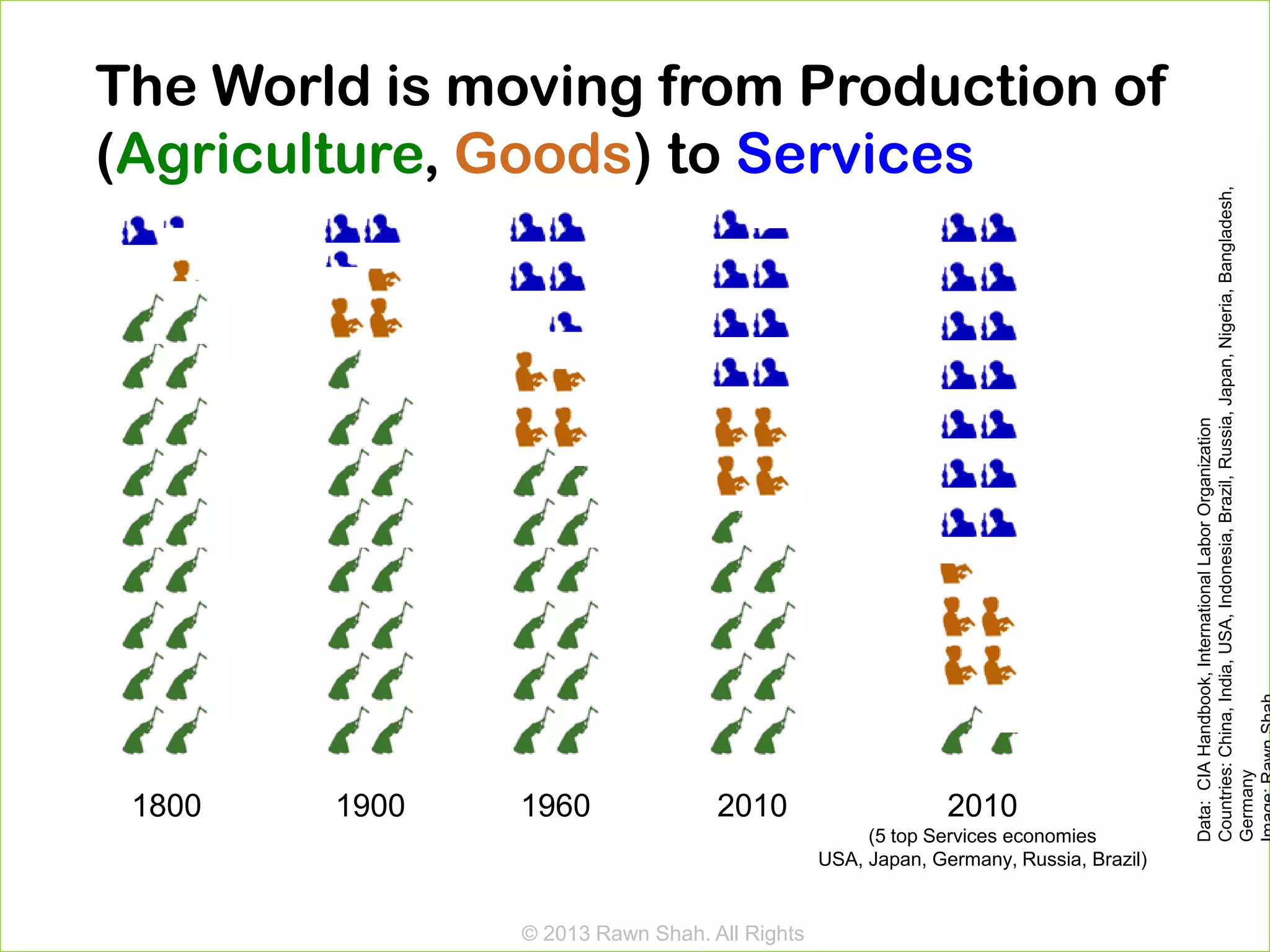
Think of it, the UK (and the British Empire before it), India, and the US have all gone through or are still in progress in these economic evolutions. In each case, we still have agriculture and goods manufacturing, but the next great opportunity seems to lies elsewhere. Today, the great opportunity seems to be in the Services-based industry that can employ a lot of thinking and working minds, while manufacturing is the midst of shifting to more affordable locations.
Each industry tends to gain enough automation and wealth for the citizens get into the next industry, with the view to a more prosperous future. Given that earlier generations of automation accelerated the productivity and output of Agriculture and Manufacturing, it shouldn’t be surprising for this same evolution to come to the Services industry next.
Economic Person1 seems to be constantly in search of finding better ways to do less work.
What does the services-based economy really get us?
In short, business agility. Nearly two decades ago, when I was focused on an emerging software technology concept called Services-Oriented Architecture (SOA), the premise was that business and technical service tasks could be defined in a digital form that can then be combined as components like Legos to build new services, enabled by ubiquitous fast network access.
Flash forward today, Web services and SOA are the hidden force behind the enormous success of the cloud industry and software APIs. Many radical businesses have emerged quickly in the digital economy because such software-defined services have been easy to rent and assemble as new market offerings. We now commonly speak of a growing speed or pace of business.
With enough ingenuity, Economic Person can invent new businesses faster than ever before without having to build them up from raw stock materials, or seen another way, our new raw stock materials are significantly more complex and useful with results far easier to build and deliver to market. That acceleration to society’s productive capacity pinned on several key ideas: service-based design and APIs, easy composability, networks, and cloud capacity rental.
This is of course a techno-centric view, but a similar model exists outside software service businesses in exchange markets selling almost any component you can think of on the likes of Alibaba (more B2B) and Amazon (more B2C). Another area is in the volume of business partnerships and cross-dependencies of supply chains. Proof enough was just how much all sorts of businesses came to pause when they lacked inventory as global supply chains were disrupted during the pandemic.
All this still requires people though. Economic Person is still quintessentially human.
So, what comes next after the Services-based economy?
The Services-oriented economy has given rise to a new problem of its own: there are simply too many services out there. In parallel, there is too much information available on the Internet (where it is freely accessible). With the number of business and individuals across the global Net, the quantity of available business services are googleplexious in variety and quantity. Inside organizations, internal systems have mirrored the problem on a smaller scale: too many service endpoints and much data to comprehend easily.
And so, Economic Person went down the Big Data road.
Analytics and machine learning made the trip so much easier to comprehend and process all that information, but we also needed an active intelligent agent to work as a proxy for us. Why drive, when you can be driven?
Economic Person asked for a chauffeur, and IT drove us right down towards machine learning and generative AI.
What is left for us mere humans?
There is a lot of chatter about what kinds of job roles will still exist in the future given all the hype and promise of AI. An example speculation: If an AI can pass a law exam — very much in the service industry – how long before we have automated lawyers? If we were to co-exist, then how exactly can humans and AI collaborate and provide value?
I’m going to explore this further in the next post, though I’d like to share two recent communities of smart folks engaged in conversations around collaboration of humans and AI.
In our community focused on distributed work culture, Asynco.org, Luis Suarez led a discussion on the impact of GenAI and Knowledge Management focusing on how AI affects people, processes, and technology. This is a great humanistic discussion on the impact on people and the security, veracity, and reliability of knowledge generated through AI.
I also came across a good explanation of this Human & AI collaboration when I saw futurist Ross Dawson’s table on LinkedIn recently, focusing on Levels of AI delegation in Decision-making (see Figure 2). Per Dawson, this is from a little while ago, and I offered to collaborate on it.
To that end, I’ve jumped on board with the Humans+AI community to explore this taxonomy of people collaborating with AI. We are looking to fine tune the categories, and document real examples. Stay tuned for more news on that.

Let’s catch up in my next piece with look at the categories and types of tasks for people considering the impact of AI.
- I will not refer to this character as ‘Economic Man’. ↩︎
 The Reconnected Organization