
• Home
  • About
    • Rawn Shah
    • Photos
    • Video & Audio
    • Cooking
  • Current Interests
    • Work Ethos
    • Collective Collaboration
    • Leadership Values
    • Enterprise Adoption
    • Process Transformation
    • Social Analytics
  • Speaking & Appearances
    • In the News
  • My Books
    • Social Networking for Business (2010)
    • Service Oriented Architecture (SOA) Compass (2006)
  • Book Reviews
  • Contact

The Reconnected Organization

The Reconnected Organization

Category Archives: Thoughts

Towards an Internet of Agents

16 Tuesday Jul 2024

Posted by rawnshah in Thoughts

≈ Leave a comment

Tags

adtech, AI, books, friends, Humans+AI, intelligent agents, Rawn Shah - Connected Business - Forbes

Let’s be honest: Reading the detailed fine print of the Terms & Conditions is not a cherished activity for anyone. Nor do we enjoy clicking through ‘Select only Necessary cookies’. More than that why should I simply give my information to a site without some sort of negotiation or exchange of what that can be used for.

These are troublesome tasks that many of us simply click through quickly without thinking of the potential forward impact. Giving our data way has long been a behind the scenes multi-billion dollar industry that we know is there but most of us don’t see directly.We are more readily willing to give up our data than our time.

Doc Searls raised my awareness on the data issues over a plate of Texas barbecue at SXSW one year, after which I wrote ‘What if We Tossed Out the Advertising Model?’ (Forbes). The answer there is a need for intelligent agents that do the busy work of negotiating for us. Doc was promoting the idea of technology enabling each of our personal agency living in a digital world where adtech vendors are getting a free ride of our data online.

Doc shared his view on agents acting as our proxies negotiating with yet other agents from vendors and web sites as to what data can be traded and to what uses. This still seems to right approach to me. After all, if you truly want to support policies like GDPR and CCPA, we need a team on our side too that can handle the many requests we have to handle every day in using the web.

This is why this paper “Internet of Agents: Weaving a Web of Heterogeneous Agents for Collaborative Intelligence” (Chen et al, 2024) by Chen Weize and researchers from Tsinghua University, Peking University, Beijing Univ of Posts and Telecommunications, and Tencent, shared recently by Mitch Lieberman, caught my eye.

INTERNET OF AGENTS: WEAVING A WEB OF HETEROGENEOUS AGENTS FOR COLLABORATIVE INTELLIGENCE
Weize Chen1, Ziming You2∗, Ran Li1∗, Yitong Guan2∗, Chen Qian1, Chenyang Zhao1 Cheng Yang3, Ruobing Xie4, Zhiyuan Liu1 , Maosong Sun1
1 Tsinghua University, 2 Peking University 3 Beijing University of Posts and Telecommunications, 4 Tencent
(Source: arXiv:2407.07061v2 [cs.CL] 10 Jul 2024)

An Internet of Agents?

I don’t really think about it much but I’m surrounded by the Internet of Things (IoT) at my house from lightbulbs to wall plugs and microwaves connected via wifi integrated into our smart home system. At night, my wife or I bid our voice assistant ‘Good night’, not out of politeness, but to turn off lights and turn on the sleep noisemaker.

Just as Google Home or Alexa can be your proxy to turn on or off lights on command, an Internet of Agents is a similar yet more generalized idea that can do be our proxy to handle even more complex tasks through AI. This looks to be another example of Humans+AI in collaboration although this could be several varieties.

First, let’s look at the Chen et al paper.

What’s in this paper?

This paper is focused on the problem of how to help many IoA agents work together in a universal way. Just like the IoT, the IoA would be a poor tool if it only could work with one pair of AI agents at a time. Instead, think of a living space of many agents each working on part of a problem to solve the overall goal. This allows each agent to specialize in one or more functions, rather than trying to build that one magic (and very complicated) AI that knows every context and can do all things for you. [Personally speaking, that is too much power in one entity that knows about me].

Therefore, to make Intelligent Agents practical, you need an Internet of Agents working together. The concept is powerful, although on reading further through the paper, I sensed an old familiar enterprise design pattern here.

It’s been some time since I last jumped into it, but the IoA approach here seems like a reinvention of Service-Oriented Architecture (SOA) and the Enterprise Service Bus (ESB) that emerged in mid-2000s. My compatriots and I, at IBM at the time, wrote Service-Oriented Architecture Compass (Bose, Fiammante, Jones, Bieberstein, Shah, 2005) to explain the concept to the world.

In plain English, SOA was a way to build complex business apps using a universal approach to describing software applications as components of a larger system. Using APIs and XML-formatted exchanges, any app component could speak to another universally. Also similarly, each component needed ways to find and connect to each other to solve problems.

Much of the paper focuses on describing the steps of how Agents work with each other, and then proving how much more efficient this IoA model — with its collection of intelligent agents working to solve problem — is to ‘larger’ more complex single agents that try to do it all in one. The similarities between this IoA proposal and SOA include:

  • A registration step to become a recognized agent in the system
  • An open channel to ask across the heterogenous population (of agents) if a certain service exists.
  • A pairing of agents (services) to agree to collaborate
  • A data exchange directly between the agents (services)
  • A sequence of multiple agents working to solve the overall problem

The difference lies in that SOA applications have to be constructed by hand by software developers and architects. They require a human conductor to orchestrate how it should all work together. Your average person is not going to want to word out how each component needs to be pieced together with another. We don’t all want to become software developers.

Another shortcoming of SOA is that the developer had to make many decisions to discover and choose from possibly many components that could do the work. It would all be simpler if there the component was smart enough to do it itself.

What is it missing?

There’s nothing wrong with having such a similarity and following a tried and true design pattern. I think it’s a good idea to do so.

What I was hoping for from the paper was particular detail on how the agents deconstruct a command such as “Review three smartphone models (Apple iPhone 13, Samsung Galaxy S22, and Google Pixel 6) based on camera quality, battery life, user interface, and price to decide the best buy” (Chen at al, 2024).

This is how people speak and we load a lot of context into it without even saying it. There are underlying assumptions that the answer will be something we can comprehend, and not just technical specifications, and a place that is nearby and convenient for us to purchase said smartphone.

The paper doesn’t clarify the process to deconstruct this query into separate tasks. It also does not share how the agent knows which ones to do itself and which to spread out to the IoA. The researchers do good work to outline how that task gets communicated, how to connect with others and collaborate in their section on “Task Assignment and Execution“, but only after that deconstruction and decisioning has been done. It might be in the paper after all and I might have simply missed it.

If an Internet of Agents can solve this challenge, then we are close to the spirit of SOA which was to make it much simpler for a software system to collaborate with other apps to solve problems for us.

Humans & AI Together Dealing with Ts & Cs

Roundtrip to my original point about the busy work of dealing with Terms & Conditions. To have a system whereby we are better armed and protected to deal with the many demands on our data and our rights, we need intelligent agents that work for us, know our contexts and can negotiate with other intelligent agents to reach an amiable solution. Behind the convenience of getting a package of Pocky chocolate wafers from the store, is a network of agents working to handle the complex logistics of global distribution, transportation, and delivery.

I see a similar future for an Internet of Agents. And in that future, the average person would still not think about the complexities involved, and rather just enjoy it.
What jobs are left for Humans?

02 Tuesday Jul 2024

Posted by rawnshah in Thoughts

≈ Leave a comment

Tags

AI, artificial-intelligence, asynco, automation, distributed work, e20, economics, economy, employment relationship, Enterprise 2.0, future of work, Humans+AI, slideshare

Humans, AI and Future of Work beyond Services-based Economies

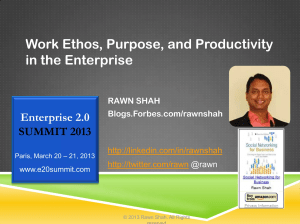
About 11 years ago, I shared a prediction that has since become very relevant with the rise of AI. My presentation at Enterprise 2.0 Paris 2013 looked at the future of job roles and job tasks given the evolution of technologies to support collaborative work. Now let’s take a look at the years ahead at what might happen as Humans and AI go to work in the same world. Will AI simply take over our jobs? Will jobs for people transform? Will we all need AI skills? What remains for humans to do?

TLDR: National economies tend to follow an evolutionary pattern for industries: Agriculture first, then Goods Production, and then Services. Each of these eventually lead to innovative automations that requires less human effort to execute, while contributing to the economic development of the nation. We then look to the next industry as the future of work. With many countries having reached the services industry, is here anything beyond ? We seem to be on the path where Automation and AI can tackle or accelerate many production or service tasks to support humans, but what types of work specifically are left for people?

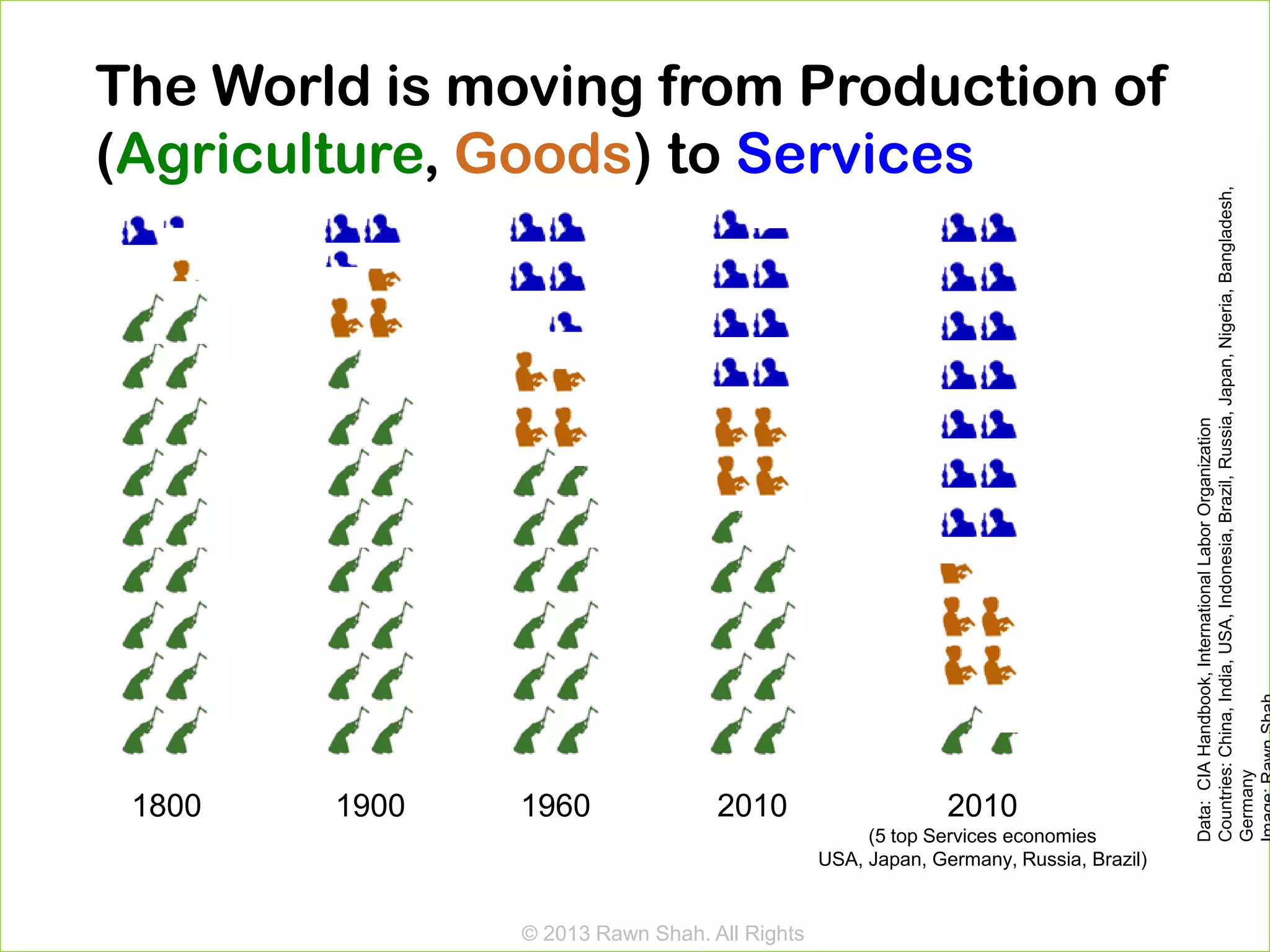
A not-so-secret long-term trend is for national economies to go through evolutionary stages of economic development starting with agriculture, then manufacturing, and finally to services. Slide 13 from my presentation shows data from the International Labor Organisation, the ILO. As nations evolve economically, pre-existing industries (e.g. agriculture) continues to persist though on a lesser significance relative to the national GDP, while the economy focuses on the next industries. This happens on the multi-generational scale (more than a century).

Fig 1. Evolution from Agriculture- to Service-based economies (source: Rawn Shah)

Think of it, the UK (and the British Empire before it), India, and the US have all gone through or are still in progress in these economic evolutions. In each case, we still have agriculture and goods manufacturing, but the next great opportunity seems to lies elsewhere. Today, the great opportunity seems to be in the Services-based industry that can employ a lot of thinking and working minds, while manufacturing is the midst of shifting to more affordable locations.

Each industry tends to gain enough automation and wealth for the citizens get into the next industry, with the view to a more prosperous future. Given that earlier generations of automation accelerated the productivity and output of Agriculture and Manufacturing, it shouldn’t be surprising for this same evolution to come to the Services industry next. 

Economic Person1 seems to be constantly in search of finding better ways to do less work.

What does the services-based economy really get us?

In short, business agility. Nearly two decades ago, when I was focused on an emerging software technology concept called Services-Oriented Architecture (SOA), the premise was that business and technical service tasks could be defined in a digital form that can then be combined as components like Legos to build new services, enabled by ubiquitous fast network access.

Flash forward today, Web services and SOA are the hidden force behind the enormous success of the cloud industry and software APIs. Many radical businesses have emerged quickly in the digital economy because such software-defined services have been easy to rent and assemble as new market offerings. We now commonly speak of a growing speed or pace of business.

With enough ingenuity, Economic Person can invent new businesses faster than ever before without having to build them up from raw stock materials, or seen another way, our new raw stock materials are significantly more complex and useful with results far easier to build and deliver to market.  That acceleration to society’s productive capacity pinned on several key ideas: service-based design and APIs, easy composability, networks, and cloud capacity rental.

This is of course a techno-centric view, but a similar model exists outside software service businesses in exchange markets selling almost any component you can think of on the likes of Alibaba (more B2B) and Amazon (more B2C).  Another area is in the volume of business partnerships and cross-dependencies of supply chains. Proof enough was just how much all sorts of businesses came to pause when they lacked inventory as global supply chains were disrupted during the pandemic.

All this still requires people though. Economic Person is still quintessentially human.

So, what comes next after the Services-based economy?

The Services-oriented economy has given rise to a new problem of its own: there are simply too many services out there.  In parallel, there is too much information available on the Internet (where it is freely accessible). With the number of business and individuals across the global Net, the quantity of available business services are googleplexious in variety and quantity. Inside organizations, internal systems have mirrored the problem on a smaller scale: too many service endpoints and much data to comprehend easily.

And so, Economic Person went down the Big Data road.

Analytics and machine learning made the trip so much easier to comprehend and process all that information, but we also needed an active intelligent agent to work as a proxy for us. Why drive, when you can be driven?

Economic Person asked for a chauffeur, and IT drove us right down towards machine learning and generative AI.

What is left for us mere humans?

There is a lot of chatter about what kinds of job roles will still exist in the future given all the hype and promise of AI. An example speculation: If an AI can pass a law exam — very much in the service industry – how long before we have automated lawyers?  If we were to co-exist, then how exactly can humans and AI collaborate and provide value?

I’m going to explore this further in the next post, though I’d like to share two recent communities of smart folks engaged in conversations around collaboration of humans and AI.

In our community focused on distributed work culture, Asynco.org, Luis Suarez led a discussion on the impact of GenAI and Knowledge Management focusing on how AI affects people, processes, and technology. This is a great humanistic discussion on the impact on people and the security, veracity, and reliability of knowledge generated through AI.

I also came across a good explanation of this Human & AI collaboration when I saw futurist Ross Dawson’s table on LinkedIn recently, focusing on Levels of AI delegation in Decision-making (see Figure 2). Per Dawson, this is from a little while ago, and I offered to collaborate on it.

To that end, I’ve jumped on board with the Humans+AI community to explore this taxonomy of people collaborating with AI. We are looking to fine tune the categories, and document real examples. Stay tuned for more news on that.

A table showing the Levels of AI delegation in Decision-making (source: Ross Dawson)

Fig 2. Levels of AI delegation in Decision-making (source: Ross Dawson)

Let’s catch up in my next piece with look at the categories and types of tasks for people considering the impact of AI.

  1. I will not refer to this character as ‘Economic Man’. ↩︎

Recent Posts

  • Towards an Internet of Agents
  • What jobs are left for Humans?
  • From Forbes: Shifting From Employee 360s To Peer Coaching
  • From Forbes: 4 Steps To Help Interview Candidates Get To Know Your Team Better
  • From Forbes: How A CIO Becomes An Agile Leader

Speaker

Workshop Speaker

Closing Keynote

Blogger-In-Residence

Speaker

Speaker

Summit Participant

Mentor

Opening Keynote

Archives

  • July 2024
  • June 2016
  • May 2016
  • April 2016
  • February 2016
  • January 2016
  • November 2015
  • October 2015
  • September 2015
  • August 2015
  • July 2015
  • June 2015
  • May 2015
  • April 2015
  • March 2015
  • February 2015
  • January 2015
  • December 2014
  • November 2014
  • July 2014
  • April 2014
  • March 2014
  • February 2014
  • November 2013
  • October 2013
  • September 2013
  • August 2013
  • July 2013
  • June 2013
  • May 2013
  • April 2013
  • August 2012

Categories

  • Alynd
  • Books
  • Forbes
  • MyForbes
  • Speaking
  • Thoughts
  • Uncategorized

Meta

  • Create account
  • Log in
  • Entries feed
  • Comments feed
  • WordPress.com

Blog at WordPress.com.

  • Subscribe Subscribed
    • The Reconnected Organization
    • Join 34 other subscribers
    • Already have a WordPress.com account? Log in now.
    • The Reconnected Organization
    • Subscribe Subscribed
    • Sign up
    • Log in
    • Report this content
    • View site in Reader
    • Manage subscriptions
    • Collapse this bar
 

Loading Comments...